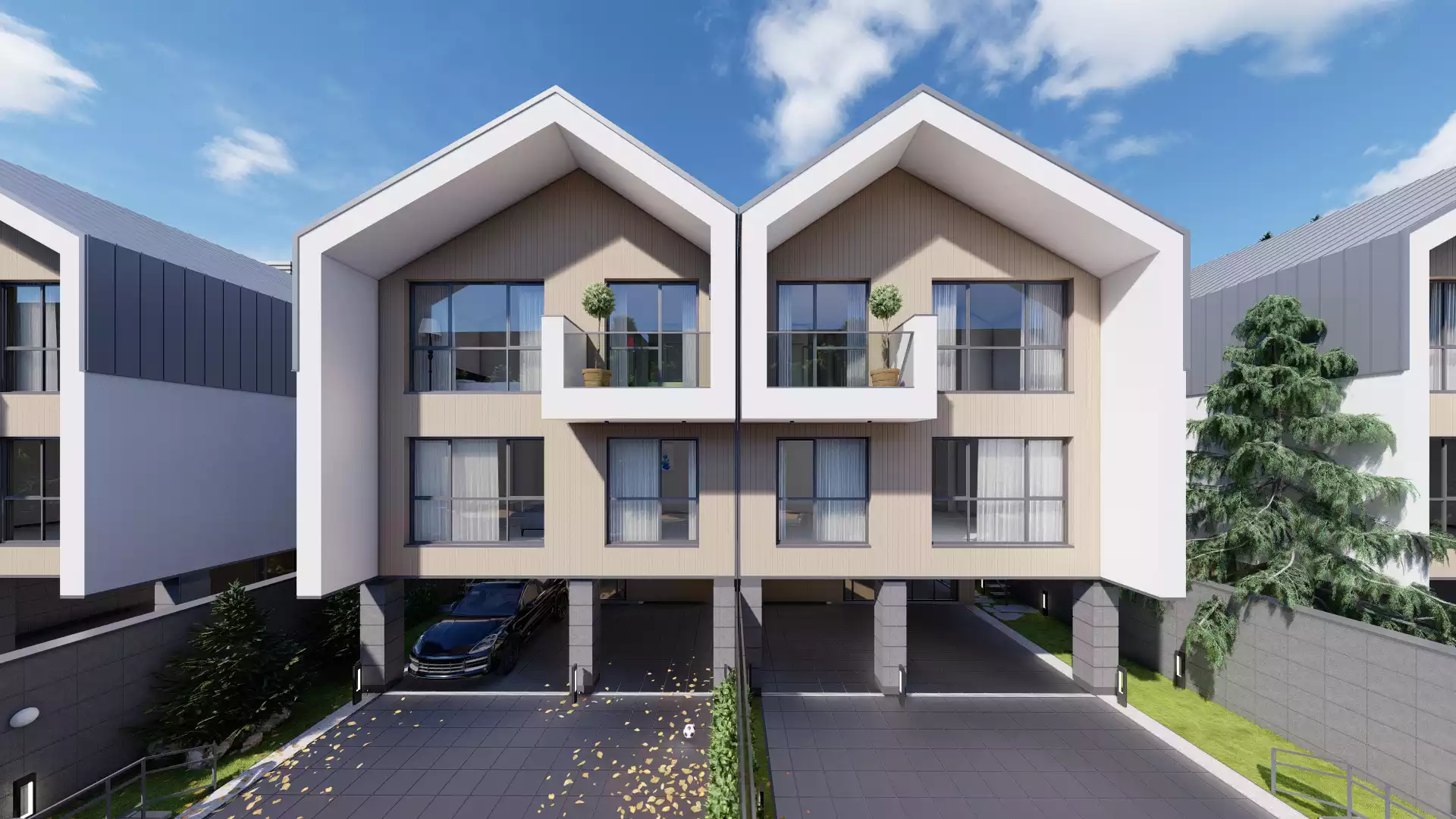
Sarvestan 2
Pardis
Tehran
The primary goal in the design of Sarvestan 2 was to establish a unified and adaptable architectural language for the entire development—one capable of creating overall harmony despite variations in villa types, sizes, and plot positions. Rather than designing each villa as an isolated object, the project was based on a strategic typological system, ensuring that the development appears coherent, ordered, and identity-driven at first glance, while still allowing each type to maintain its own controlled variation
Design Strategy and Typological System
The project was organized around four primary villa types. These types share a common logic in spatial organization, volumetric proportions, and structural and construction principles, while subtle variations in façade treatment, entrances, and architectural details create necessary differentiation. The typological approach was selected to:
-
Enable cost-efficient repetition and faster construction
-
Improve the overall visual quality of the development at the street façade and skyline scale
-
Provide a clear façade guideline to maintain architectural continuity across different plots
Landscape and Urban Identity of the Development
At the scale of the residential town, the project’s identity is shaped not only by the buildings themselves, but also by the integration of entrances, street edges, pedestrian and vehicular paths, and landscape design. In alignment with the architectural language, the project aimed to:
-
Create clear and organized entry sequences and perimeter edges
-
Establish a consistent logic for each villa’s front zone, including entrance, parking, and private yard
-
Use vegetation as a “softening layer” to enhance the architectural character and improve the environmental quality of the development over time
Architectural Expression and Façade Concept
The architectural language of the development is based on a contemporary reinterpretation of the familiar “house” archetype—a form that conveys both domestic warmth and urban legibility:
Pitched (Gable) Roofs:
Used as a shared signature across all types, creating a unified skyline and a rhythmic streetscape.
Continuous Light-Colored Frame:
A clear and consistent frame wraps the volumes, acting as a protective outer layer that enhances legibility and reinforces the family relationship between different villa types.
Warm Intermediate Material Layer:
Materials such as wood, thermowood, or similar finishes are used in the middle layer of the façade to introduce warmth, reduce the visual heaviness of larger volumes, and strengthen the residential character.
Framed and Recessed Balconies:
These semi-private outdoor spaces provide shading, enhance façade depth, and improve overall living quality while contributing to the architectural composition.
Controlled Rhythm of Openings:
Window proportions and placement are carefully regulated to maintain visual harmony across different villa types while preserving individual variation.